There’s something instantly exciting about spotting a red bird. Whether it flashes across your backyard, lands on a feeder, or sings from the top of a tree, that bright red color is hard to miss and even harder to forget.
If you searched for red birds, chances are you want a quick answer first: what kind of red bird am I looking at? The good news is that a few common clues can help you narrow it down fast, even before you reach for binoculars.
In North America, the bird most people think of first is the Northern Cardinal. It’s bright red, medium-sized, has a noticeable crest, and a thick orange-red bill. If the bird you saw looked bold, elegant, and almost completely red, a cardinal is usually the top guess.
If the bird was smaller and more compact, especially around feeders, it may have been a House Finch. Males often show red on the head, chest, and upper body, but not usually the same fully saturated red you see on a cardinal. Their coloring can look more rosy or patchy, which is a helpful clue.
Another possibility is the Purple Finch, which often looks like it was “dipped in raspberry juice.” Its red coloring tends to spread more evenly across the head and chest than a House Finch, giving it a richer and softer look. People often confuse these two, so size, shape, and color spread matter a lot.
If the bird looked a little more unusual or was seen in woodland areas, you might be looking at species like the Scarlet Tanager, Summer Tanager, or even a Vermilion Flycatcher, depending on your location. Some red birds are backyard regulars, while others are more seasonal, regional, or tied to specific habitats.
To identify a red bird quickly, focus on these five things first:
1. Look at where the red appears
Is the whole bird red, or just the head, throat, or chest?
A fully red bird points you toward species like the Northern Cardinal or Summer Tanager, while partial red often suggests finches or woodpeckers.
2. Check the beak shape
A thick, seed-cracking beak usually means a finch or cardinal.
A slimmer beak may point to insect-eating birds like tanagers or flycatchers.
3. Notice the size and body shape
Some red birds are chunky and strong-looking, while others are slim and delicate. Shape can help just as much as color.
4. Pay attention to habitat
Was it in a backyard feeder, deep woods, open field, desert area, or wetland edge? Different red birds prefer very different places.
5. Consider your region and the season
Some red birds are common year-round, while others appear only during migration or breeding season. Location makes a big difference.
A quick note that helps many beginners: not every “red bird” is truly red from head to tail. Some are more crimson, rusty, orange-red, or rose-colored. Light also changes how feathers appear, especially in early morning or late afternoon. That’s why it helps to look at the whole bird, not just the color.
The easiest way to think about red birds is this:
- Bright red with crest and thick bill = likely Northern Cardinal
- Small feeder bird with red face and chest = likely House Finch
- Rosy-red finch with fuller red wash = likely Purple Finch
- Brilliant red bird in forest or treetops = possibly Scarlet Tanager
- Clear red bird with simpler shape and no crest = possibly Summer Tanager
If you’re not sure yet, don’t worry. That’s completely normal. Red birds are beautiful, but some of them can be surprisingly tricky to tell apart at first glance. The rest of this guide will walk you through the most common species, key differences, and simple ways to identify them with confidence.
What Counts as a Red Bird? Full Red vs Red Head vs Red Chest
Not every bird that people call a red bird is actually red from head to tail. This is one of the biggest reasons bird identification can feel confusing at first. You spot a flash of red, try to match it to a photo online, and suddenly half a dozen different birds seem possible.
The easiest way to make sense of it is to group red birds into three simple categories: fully red birds, birds with red on the head, and birds with red on the chest or body. Once you know which group your bird fits into, identification gets much easier.
Fully red birds
These are the birds most people picture right away when they hear the phrase red bird. They appear mostly or almost entirely red at a glance, especially the males.
A classic example is the Northern Cardinal. The male is bright red over nearly the whole body, with a black mask around the face and a strong orange-red bill. This is the bird many people mean without realizing they’re naming just one species.
Other birds can also look largely red, depending on where you live. The Summer Tanager is another good example. Male Summer Tanagers can look beautifully even-toned red, often with a softer and smoother appearance than a cardinal. In some regions, birds like the Scarlet Tanager may also appear vividly red, though their black wings make them easy to separate once you get a better look.
If the bird you saw looked red all over, your best clues are:
- overall body shape
- presence or absence of a crest
- bill thickness
- wing color contrast
Birds with a red head
Some birds are not fully red, but their head is the first thing you notice. This can create a strong “red bird” impression, even when the rest of the body is brown, gray, black, or patterned.
This is common with species such as the House Finch, where males often show red on the forehead, face, and upper chest. From a distance, that red facial area may stand out more than the rest of the body, especially at a feeder.
Woodpeckers can also fall into this category. Some species have a bright red crown or patch on the head, but they are not truly red birds overall. That’s why it helps to ask: Is the whole bird red, or am I mostly noticing one bright red area?
If the red seems concentrated on the head, look carefully at:
- whether the back and wings are streaked or patterned
- whether the bird clings to tree trunks
- whether the body is mostly brown, gray, or black-and-white
Birds with a red chest or body wash
This group includes birds that show red mainly across the chest, throat, or upper breast, sometimes with red spreading lightly into other areas. These birds often cause the most confusion because their color can vary a lot depending on age, sex, diet, season, and lighting.
The House Finch is a perfect example. Many males have a red chest and red face, but the red may look uneven or patchy. The Purple Finch can also fall into this category, although its color often appears richer, deeper, and more smoothly blended.
Some birds may look rose-red, raspberry-red, or even orange-red rather than true bright red. That still puts them in the “red bird” conversation for most people, especially if the chest or front of the bird is what catches the eye first.
When the red is mainly on the chest or breast, try to notice:
- whether the red is bold or softly blended
- whether the belly stays pale or streaked
- whether the bird looks slim, rounded, or heavy-bodied
Why this matters for identification
This simple breakdown saves time because it helps you avoid comparing your bird to every red species at once. Instead, you can ask one quick question first:
Was the bird fully red, red-headed, or red-chested?
That one step instantly narrows the field.
It also helps explain why so many bird photos online feel misleading. Two birds can both be called red birds, but one may only have a red face while another is bright red across nearly the entire body. Without this distinction, it is very easy to misidentify what you saw.
A helpful tip before moving on
Color alone is never the whole answer. A bird’s:
- shape
- bill
- habitat
- behavior
- season
- region
all matter just as much.
So if you saw a red bird and you’re unsure what it was, start with the color pattern first, then build from there. That makes the search feel much simpler and a lot less overwhelming.
In the next section, we’ll look at the most common red birds in North America so you can quickly compare the species people see most often.
1. Northern Cardinal

The Northern Cardinal is probably the first bird many people think of when they hear the words “red bird.” It is easy to understand why. The male Northern Cardinal is a vivid, rich red from crest to tail, with a black mask around the face that makes its features stand out even more. The female is not as bright, but she is beautiful in her own way, with warm brown feathers touched with soft red on the wings, tail, and crest.
This bird is common across much of the eastern and central parts of North America. Cardinals enjoy shrubby areas, woodland edges, parks, suburban neighborhoods, and backyard gardens. If you put out sunflower seeds, there is a good chance a cardinal will eventually show up, especially if you live within its range. They seem quite comfortable around people, which is one reason they are so widely loved.
orthern Cardinals are also known for their strong, clear songs. Both males and females sing, which is a little unusual among songbirds. Their calls can sound bright and whistling, and once you learn them, they become easy to recognize. Cardinals are often seen in pairs, and they tend to stay in the same general area year-round instead of migrating long distances.
There is something especially comforting about the Northern Cardinal. It feels familiar, dependable, and bright. In the middle of winter, when trees are bare and colors are muted, a cardinal can look like a little piece of living holiday decoration. It is no surprise that this bird has become one of the most beloved backyard species in North America.
2. Summer Tanager
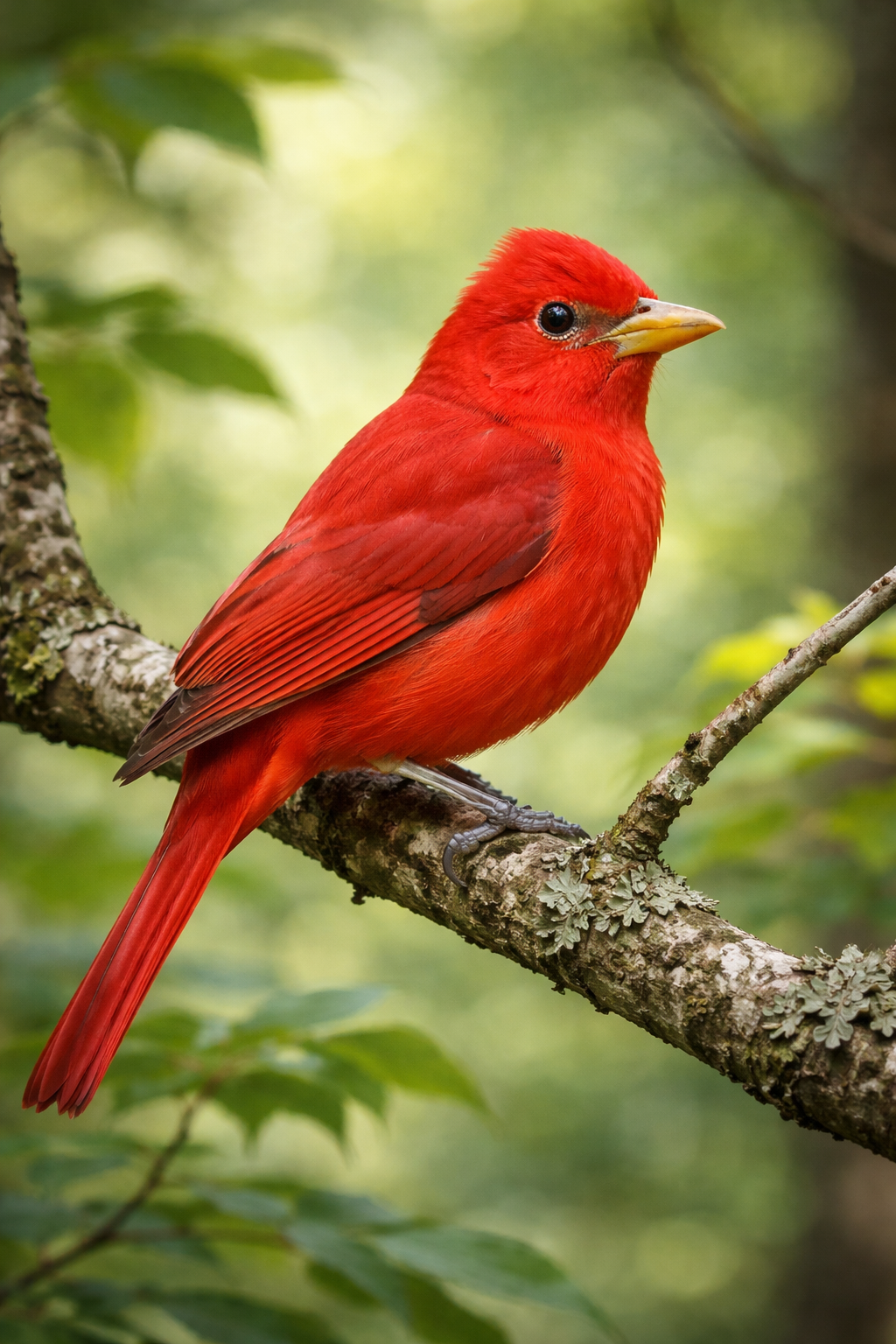
The Summer Tanager is a lovely bird that often surprises people because the male is almost entirely rosy red. Unlike some red birds that have black wings, streaks, or contrasting patches, the male Summer Tanager appears softly and evenly red all over. The female looks completely different, with yellowish-green plumage that helps her blend into the leafy trees where she spends much of her time.
These birds are found mainly in the southern United States during the breeding season, especially in open woodlands, forest edges, and areas with scattered tall trees. They migrate to warmer regions for the winter, so in many places they are only seasonal visitors. Because they often stay high in the trees, they can be a little harder to spot than a cardinal at a feeder.
One of the most interesting things about the Summer Tanager is its diet. It is especially fond of bees and wasps. In fact, it is known for catching them in midair, then removing the stinger by rubbing the insect against a branch before eating it. That alone makes it a fascinating bird to watch. It also eats other insects and some fruit.
The Summer Tanager has a gentle, understated beauty. Its red is not as flashy or dramatic as some other species, but it has a warm, elegant quality that makes it memorable. Spotting one can feel like discovering a hidden gem in the treetops. It is the kind of bird that reminds you to slow down and really look, because not all beauty announces itself loudly.
3. Scarlet Tanager
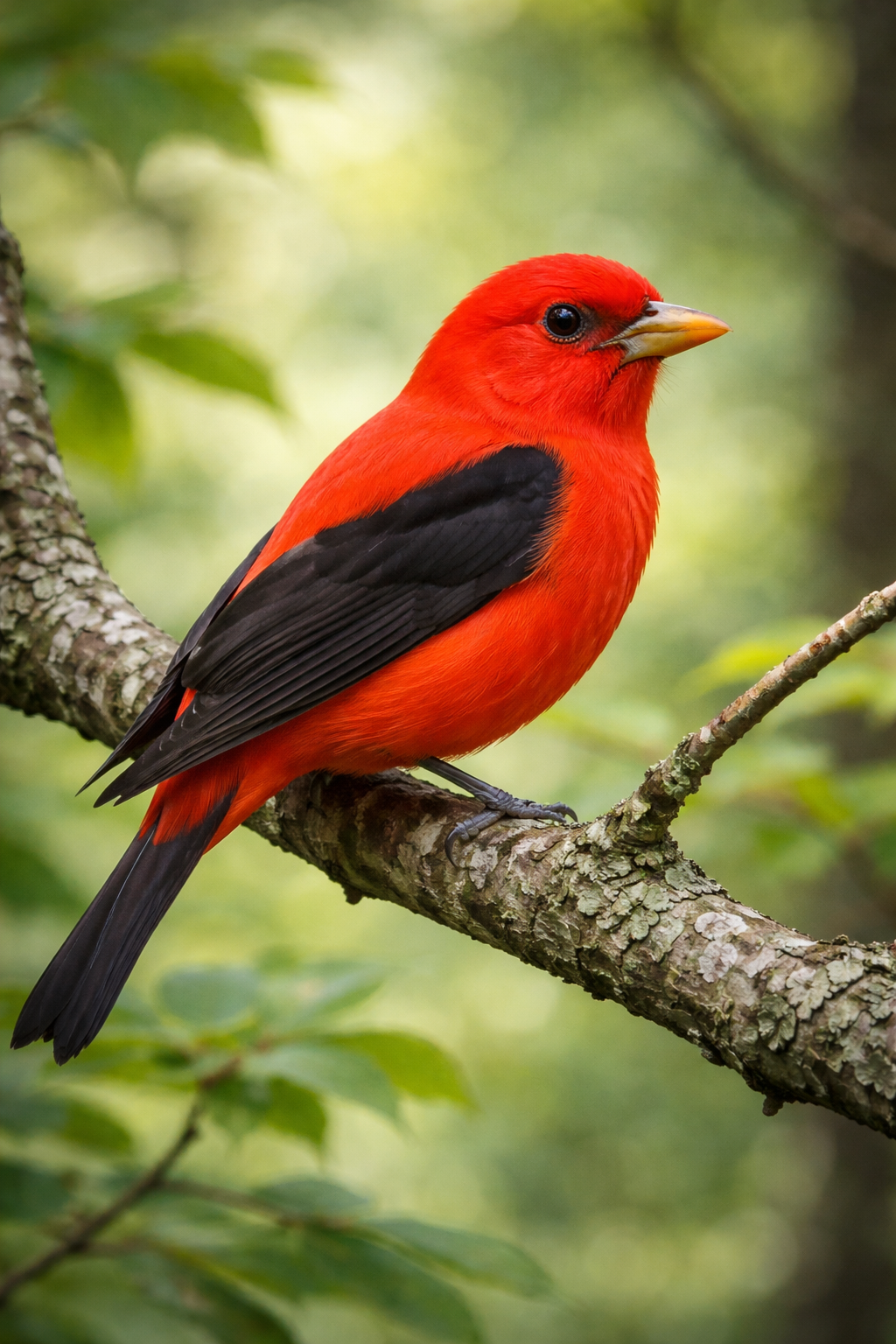
If the Summer Tanager is softly handsome, the Scarlet Tanager is downright striking. The breeding male has a brilliant scarlet-red body paired with jet-black wings and tail. The contrast is so bold that it almost looks unreal when sunlight hits the feathers just right. The female, on the other hand, wears olive-yellow tones that help her remain well camouflaged in the forest.
Scarlet Tanagers breed in mature deciduous forests across the eastern United States and southern Canada. They spend much of their time high in the canopy, which means people often hear them before they ever see them. Their song can sound a bit like a robin’s, though rougher and less polished. During migration, they travel long distances to wintering grounds in Central and South America.
Because they prefer forest interiors, Scarlet Tanagers are not usually everyday backyard birds. Seeing one often requires a walk in the woods, a bit of patience, and a willingness to scan the upper branches. But that effort makes the sighting even more rewarding. A bright red bird high against a background of green leaves is something most bird lovers remember for a long time.
The Scarlet Tanager has a dramatic, almost storybook quality. It feels like one of those birds that should belong in a painting rather than in real life. Yet there it is, flashing red through the treetops. For many birdwatchers, catching sight of a Scarlet Tanager is one of the highlights of spring and early summer.
4. Vermilion Flycatcher

The Vermilion Flycatcher is one of the brightest red birds in North America, and in some ways it looks almost too colorful for the dry landscapes where it lives. The male has vivid red underparts and head, paired with dark brown or blackish upperparts, wings, and tail. The female is much subtler, with grayish-brown feathers and only hints of peachy or reddish coloring underneath.
This species is most often found in the southwestern United States, especially in open country, desert edges, scrubby habitats, and places near water. It likes areas where it can perch out in the open and watch for insects. Once it spots prey, it darts out quickly, grabs it in the air, and returns to a perch. This “sit and sally” hunting style is typical of flycatchers and fun to observe.
Although small, the Vermilion Flycatcher has a big personality. The male often chooses very visible perches, almost as if he knows how stunning he looks. When sunlight catches his feathers, the red can seem almost glowing. Even people who are not especially interested in birds tend to stop and stare when they see one.
What makes the Vermilion Flycatcher so special is the contrast between bird and setting. In a landscape of dust, cactus, dry grass, and pale sky, this little flash of red feels like a miracle. It is proof that even in places that seem muted or harsh, nature still finds ways to be vivid and joyful.
5. House Finch
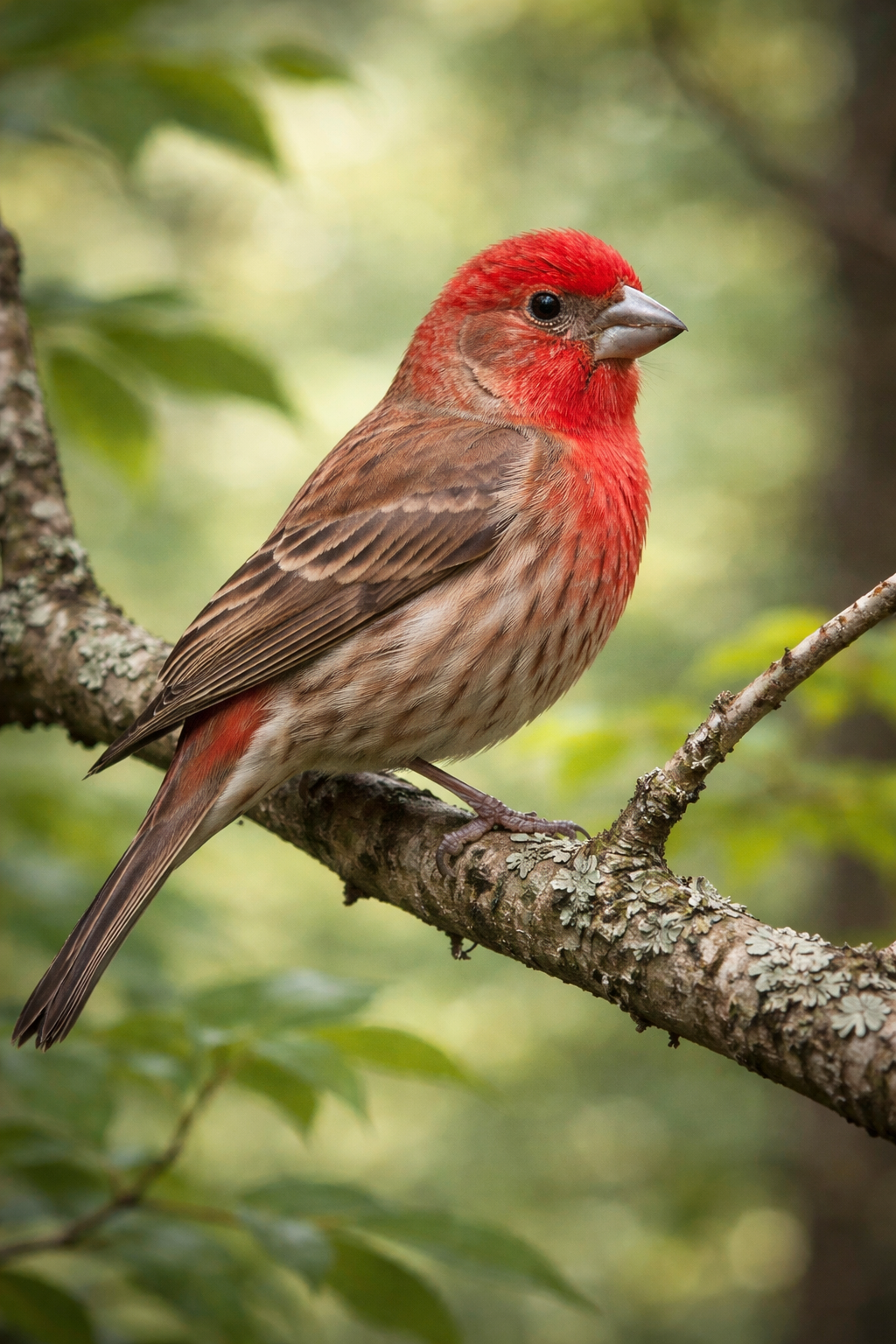
The House Finch is one of the most familiar red-toned birds in North America, especially in towns, suburbs, and cities. The male has red coloring on the forehead, throat, and upper chest, though the shade can vary from rosy pink to a deeper red. The rest of the body is brown and streaked. Females do not have red plumage and are mostly brown with blurry streaks.
House Finches are highly adaptable birds. They seem perfectly happy around people and often gather at feeders, in hedges, on utility lines, and around buildings. Their range has expanded widely, and today they are among the most common birds many people see in everyday life. Because they are social, they often arrive in small groups rather than alone.
These finches eat seeds, buds, fruit, and other plant material. They are frequent visitors to seed feeders, especially those offering sunflower or nyjer seed. Their song is a lively, cheerful jumble of notes, and their constant chattering adds a friendly soundtrack to many neighborhoods.
What makes the House Finch especially charming is its ordinary presence. It may not seem as exotic or dramatic as a Scarlet Tanager or Vermilion Flycatcher, but that is part of its appeal. This is a bird that brings color into daily life without asking you to travel far or search hard. It is there on the fence, at the feeder, or perched on the roof, adding a touch of red to the everyday world.
6. Purple Finch

Despite its name, the Purple Finch is really more raspberry-red than purple. Birders sometimes describe the male as looking as though it was dipped in berry juice. The red wash covers much of the head, chest, back, and sides, blending into brown on the wings and tail. Females are brown and white with crisp streaking and a noticeable pale stripe above the eye.
Purple Finches are found in parts of Canada, the northeastern United States, and some western mountain forests. They prefer coniferous and mixed forests, though they also visit feeders, especially in winter. In some years they may appear in larger numbers farther south, depending on food availability.
These birds can easily be confused with House Finches, especially by beginners. But once you learn the differences, they become easier to tell apart. Purple Finches usually look chunkier, with a stronger build and a more even raspberry wash that extends farther over the body. House Finches tend to have more limited red on the face and chest, with heavier streaking below.
The Purple Finch feels a little more special partly because it is less predictable in many areas. Seeing one at the feeder can be an exciting surprise. Its rich coloring has a softer, deeper quality than the bright red of a cardinal, and that gives it a quiet elegance. It may not be flashy in the same way, but it has a beauty that rewards a closer look.
7. Red Crossbill

The Red Crossbill is one of the most unusual birds on this list. Males are often reddish or reddish-orange, while females are usually more yellowish or olive. But what really makes this bird stand out is its bill. The tips of the upper and lower mandibles cross over each other, creating a tool specially designed for prying seeds out of conifer cones.
These birds live mainly in conifer forests, where they depend heavily on pine, spruce, fir, and other cone-bearing trees. Instead of following a regular migration route, Red Crossbills move around in response to cone crops. If one area has poor seed production and another has an abundance, the birds may shift accordingly. That nomadic lifestyle can make them hard to predict from year to year.
Watching a Red Crossbill feed is fascinating. It uses its oddly shaped bill with surprising skill, twisting it between cone scales and pulling out the seeds inside. What might look awkward at first glance is actually a wonderfully specialized adaptation. Nature has shaped this bird for a very particular job, and it performs that job beautifully.
The Red Crossbill has a wild, forest-dwelling character that makes it feel a bit mysterious. It is not the kind of bird everyone sees regularly, and perhaps that adds to its charm. It reminds us that birds are not only colorful and musical but also incredibly well adapted to their environments. This one is a specialist, and a very memorable one.
8. Painted Bunting
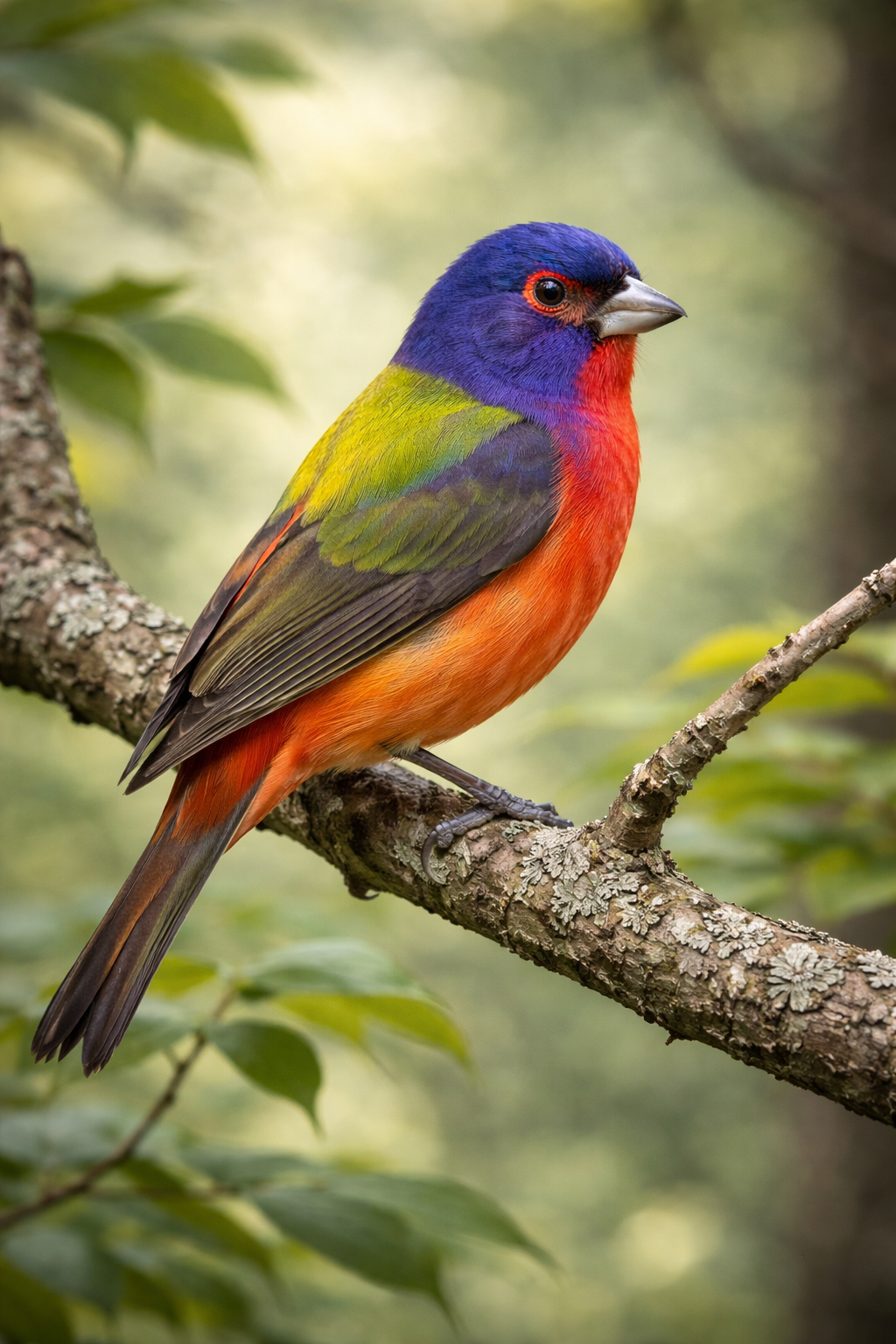
The Painted Bunting is sometimes called one of the most beautiful birds in North America, and it is hard to argue with that description. The male is a dazzling combination of colors, with a blue head, green back, and red underparts. The female is bright green overall, which helps her remain hidden among leaves and grasses. Although it is not entirely red, the male’s red chest and belly absolutely earn it a place on this list.
Painted Buntings are found mainly in the southeastern and south-central United States during the breeding season. They like brushy habitats, woodland edges, gardens, thickets, and areas with dense cover. Despite their bright colors, they can be surprisingly hard to see because they often stay low and hidden.
Their diet includes seeds and insects, and they sometimes visit feeders stocked with white millet or other small seeds. Males sing during the breeding season, often from somewhat concealed perches. When you finally get a good look at one, it can feel almost unreal. The colors are so vivid that the bird looks more like tropical artwork than a familiar North American songbird.
The Painted Bunting brings a sense of delight wherever it appears. It is the kind of bird that makes people smile instantly. Even experienced birdwatchers still feel a thrill when they see one. In a continent full of beautiful birds, the Painted Bunting manages to look especially festive, almost as though it was designed to celebrate color itself.
9. American Robin
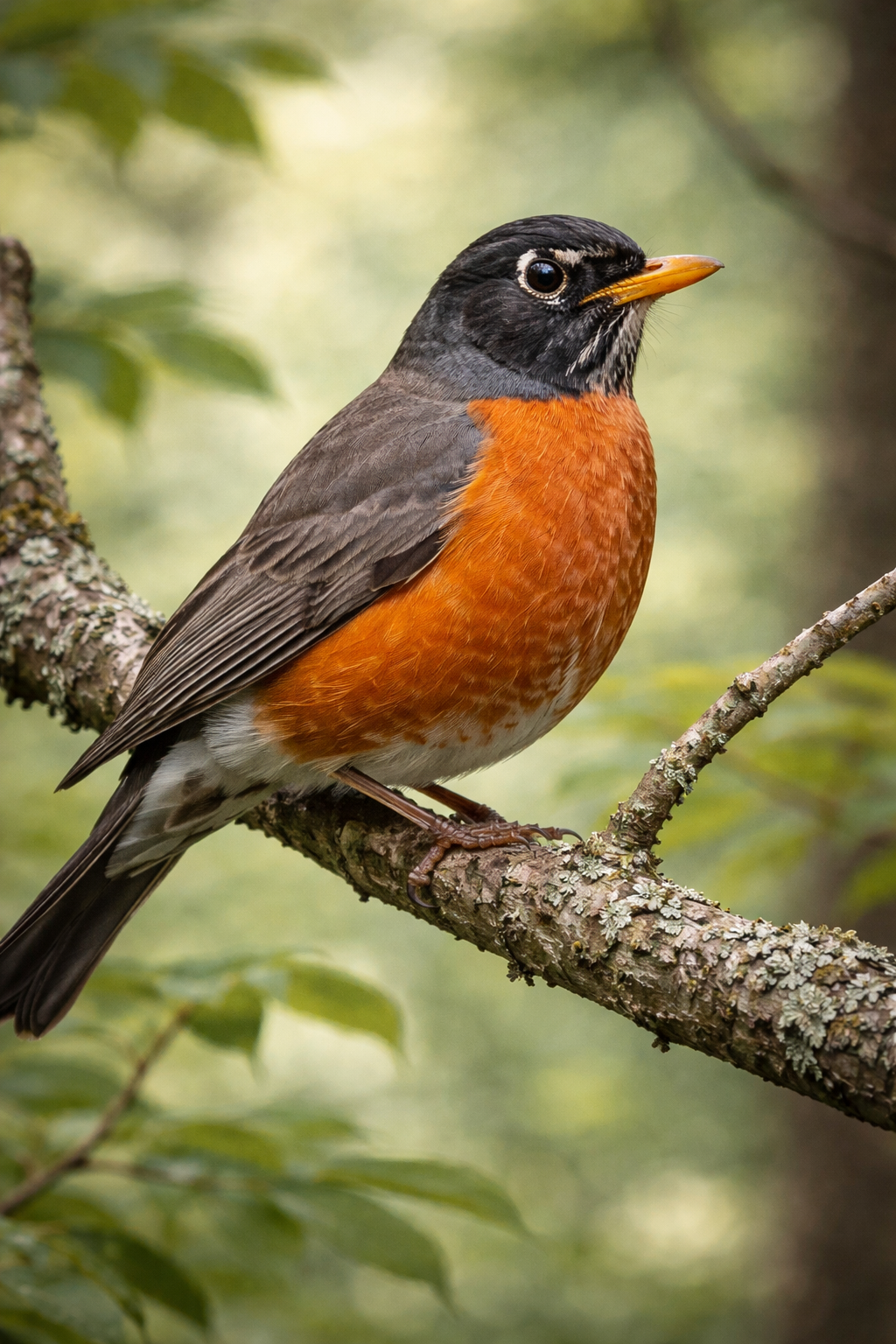
At first glance, the American Robin may seem like an unusual choice for a list of red birds. After all, it is not bright scarlet or crimson. But its warm rusty red-orange breast is one of the most familiar and recognizable bits of bird color in North America. For many people, the robin is one of the first birds they learned to identify.
American Robins are found across a huge range of habitats, including lawns, gardens, parks, forests, and suburban neighborhoods. They are often associated with spring, though many stay in some regions year-round. Their upright posture, hopping movement, and habit of pausing to listen for worms in the grass make them easy to recognize.
Robins eat a varied diet of earthworms, insects, and fruit. In spring and summer, they are often seen pulling worms from lawns. In colder months, they may gather in flocks and feed on berries. Their song is one of the classic sounds of early morning in many parts of North America, full of rich, clear phrases that feel cheerful and familiar.
What makes the robin special is not rarity or dramatic color, but its place in everyday life. It is woven into seasons, memories, and ordinary mornings. Its red-orange breast may be softer than the bright red of a cardinal, but it still carries warmth. The American Robin reminds us that color in nature does not always need to be bold to be beautiful.
10. Red-headed Woodpecker
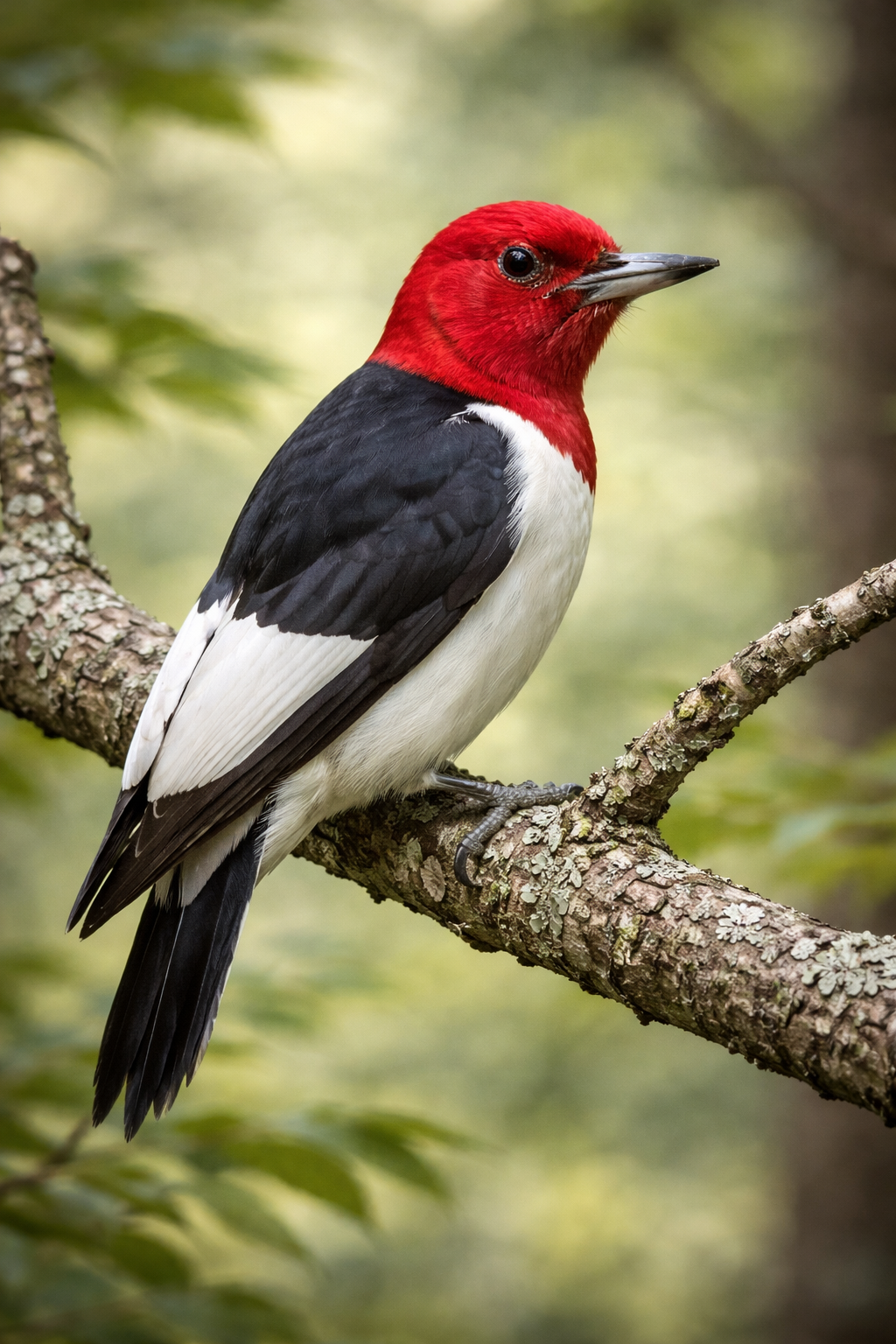
The Red-headed Woodpecker is one of the boldest-looking birds in North America. As its name suggests, the head is entirely bright red, and the rest of the bird is sharply patterned in black and white. The result is clean, striking, and unmistakable. Unlike some woodpeckers with just a red patch, this bird wears its color proudly and fully.
It is found in open woodlands, orchards, groves, savannas, and places with dead trees or snags suitable for nesting. It is less common than it once was, which makes seeing one feel especially meaningful. Red-headed Woodpeckers nest in cavities and use their strong bills to excavate or enlarge nesting sites in dead wood.
Their feeding behavior is also interesting. In addition to insects, they eat nuts, seeds, acorns, and fruit. They may catch insects in midair, store food for later, and visit trees or fences in search of prey. Their flight is strong and direct, and when one flashes past, the bold blocks of red, black, and white are unforgettable.
There is a certain confidence about the Red-headed Woodpecker. It does not blend in gently like a forest tanager, nor does it simply brighten a feeder like a finch. It makes a statement. Its vivid color and graphic patterning give it a dramatic presence, and for many bird lovers, it is one of the most exciting woodpeckers to encounter.
Conclusion
North America’s red birds come in many forms, and that is part of what makes them so fascinating. Some, like the Northern Cardinal and House Finch, are familiar companions in backyards and neighborhoods. Others, like the Scarlet Tanager, Vermilion Flycatcher, and Red Crossbill, may require a little more patience, luck, or travel to find. Some are fully red, while others carry their color in just one striking area, like the robin’s warm breast or the woodpecker’s brilliant head.
Together, these birds show the wonderful variety of the natural world. They live in deserts, forests, suburbs, open fields, and mountain woodlands. They eat seeds, insects, fruit, and even stinging insects. They sing from treetops, perch on fence posts, visit feeders, and flicker through the canopy in quick flashes of color.
Perhaps that is why red birds feel so special. They are not all the same, and they do not all appear in the same places. But each one, in its own way, offers a small moment of beauty and surprise. Whether you see a cardinal outside your kitchen window or catch a glimpse of a Scarlet Tanager deep in the woods, the feeling is similar: a pause, a smile, and a quiet sense of wonder. That is the gift of red birds, and it never really gets old.


